Stories
The Last Civil Servant
A fictional zombie-apocalypse story. Not official government advice or a live emergency bulletin.
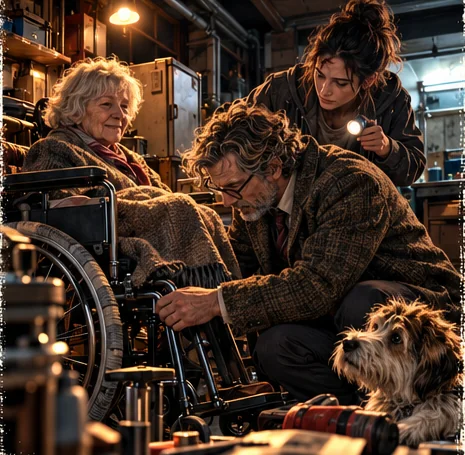
A matter of wheels
Bernard P. Wetherby had never considered a wheelchair to be a particularly controversial item of equipment. It had wheels. It had a seat. It was designed to move people who could not comfortably move themselves. As government procurement went, it was refreshingly straightforward.
Unfortunately, there was not one immediately available.
There was, however, a deceased gentleman in a dressing gown attempting to enter the kitchen. Bernard felt this presented a certain imbalance in their operational priorities.
The kitchen door shuddered under another impact. Eleanor stood beside the refrigerator, gripping a bread knife. Mrs Margaret Finch remained on the floor, her injured ankle supported by a folded tea towel. Mr Pickles was stationed before the barricade, growling with the intensity of a much larger animal.
“Right,” Bernard said. Nobody moved. He cleared his throat. “I believe we require a plan.”
“We require a way out,” Eleanor replied.
“Yes. That would form the principal component.”
Another blow shook the door. Bernard examined the kitchen. There were cupboards, a table, four chairs, a washing machine and a large collection of ornamental plates depicting various seaside resorts. He briefly considered the washing machine. It was on castors, but the idea was clearly ridiculous.
Then he noticed a folding shopping trolley beside the back door. Two wheels. A metal frame. A faded tartan bag. He regarded it thoughtfully.
Eleanor followed his gaze. “No.”
“I haven't said anything.”
“You're thinking about putting her in that.”
“Certainly not. It would be entirely unsuitable.”
“Good.”
“I was merely considering whether the wheels might be useful.”
Eleanor stared at him. Bernard looked at the trolley again. “Although they do appear rather small.”
An unexpected contribution from the deceased
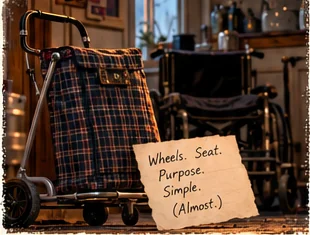
Mrs Finch, who had been watching this discussion with increasing irritation, cleared her throat. “If you two have quite finished redesigning my shopping trolley, there's a wheelchair in the garage.”
Bernard turned. “I'm sorry?”
“My husband's. He had a bad hip. We kept it after he died.”
There was a brief silence. Eleanor lowered the bread knife.
“Margaret,” she said, “why didn't you mention that earlier?”
“Nobody asked.”
Bernard closed his eyes. He had encountered this problem throughout his professional life. Vital information, withheld not through malice or secrecy, but because the correct question had not been asked.
“Where is the garage?” he enquired.
“Through the utility room.”
“Is it accessible from inside the house?”
“Yes.”
Bernard felt the first small stirrings of optimism. “Excellent.”
“Except the door sticks.”
The optimism retreated.
“And the wheelchair has a flat tyre.”
It departed entirely.
Outside, the dead man struck the kitchen door again. Mrs Finch looked towards the noise.
“Whoever that is, he's being terribly rude.”
Bernard adjusted his spectacles. “Yes, Mrs Finch. We have already noted his conduct.”
The garage
The utility room smelled of damp laundry and furniture polish. Bernard and Eleanor squeezed past a tumble dryer, a stack of old newspapers and an enormous bag of birdseed.
The garage door resisted their first attempt to open it. And their second. On the third attempt Eleanor gave it a sharp kick. It swung inward.
Bernard looked at her. “An unconventional approach.”
“It worked.”
“Yes. I shall record it as an emergency exception.”
The garage was dark. Eleanor switched on her torch. There were shelves of paint tins, gardening tools, Christmas decorations and several cardboard boxes marked IMPORTANT, the contents of which appeared to consist primarily of old curtains.
Against the far wall stood a folded wheelchair. Bernard approached it with something approaching reverence.
“Splendid.”
He unfolded it. One wheel turned freely. The other did not. He examined the tyre. Flat, as advertised.
“Do you know anything about bicycles?” Eleanor asked.
“A little.”
“Good. There's a pump over there.”
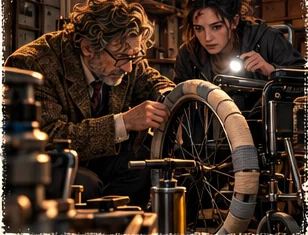
Bernard retrieved it. For several minutes he worked at the tyre valve while Eleanor held the torch. The pump wheezed. The tyre slowly expanded.
Bernard smiled. “Progress.”
Then the valve hissed. The tyre deflated.
Bernard stared at it. “Ah.”
Eleanor folded her arms. “Now what?”
Bernard considered the question. He had once attended a departmental seminar entitled Resilience Through Adaptive Thinking. The seminar had involved constructing a bridge from drinking straws and discussing the importance of flexibility. He had considered it a waste of public money.
Nevertheless, one principle had remained with him. When the intended solution was unavailable, one must identify the minimum acceptable alternative.
He looked around the garage. A roll of heavy-duty tape lay on a shelf. Beside it was a length of foam pipe insulation.
Bernard picked them up. Eleanor raised an eyebrow. “You're not seriously going to repair a wheelchair with that?”
“No,” Bernard said. “I'm going to attempt to make a temporary wheel covering.”
“Will it work?”
“I have absolutely no idea.”
He began wrapping the foam around the rim. It was not elegant. It was not quiet. But when he pushed the chair across the garage floor, it moved.
Bernard regarded his handiwork. “Provisionally satisfactory.”
A departure under difficult circumstances
Getting Mrs Finch into the wheelchair required considerable effort. She was determined to assist. Her ankle was equally determined that she should not.
Bernard supported her shoulders while Eleanor helped her rise. Mr Pickles supervised from beneath the kitchen table. At last Mrs Finch was seated, pale but smiling.
“Well,” she said, “that wasn't so bad.”
Bernard, whose back was now protesting vigorously, chose not to comment.
The banging at the kitchen door had stopped. This was not reassuring.
Eleanor peered through the curtains. “He's gone.”
Bernard looked at her. “Gone where?”
“I can't see him.”
“That is not quite the same thing.”
They agreed to leave through the garage. Bernard opened the outer door a few inches. The street beyond was empty. A light breeze moved discarded newspapers along the pavement. Somewhere in the distance, a car alarm sounded.
He opened the door farther. “Clear.”
Eleanor pushed the wheelchair towards the opening. The improvised wheel covering made a peculiar scraping sound.
Mrs Finch looked down. “What have you done to it?”
“A temporary modification.”
“It sounds like a lawnmower.”
“Yes,” Bernard admitted. “There are certain acoustic limitations.”
They emerged into the afternoon light. For one extraordinary moment, everything seemed almost normal.
Then Mr Pickles barked.
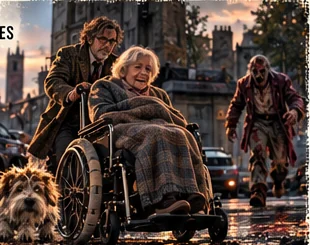
Bernard turned. The man in the dressing gown stood at the end of the driveway. He had apparently found another way around the house.
“Good heavens,” Bernard said.
Eleanor seized the wheelchair handles. “Move!”
They moved.
The fastest wheelchair in Church Lane
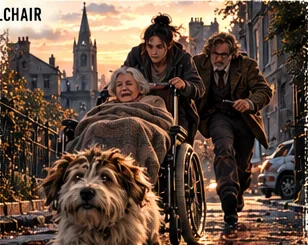
Bernard had never run particularly quickly. At school he had been described as enthusiastic but unsuited to competitive athletics. His greatest sporting achievement had been finishing third in a departmental charity walk after the two leading participants took a wrong turning.
Nevertheless, he now discovered that fear was an excellent motivator.
Eleanor pushed the wheelchair. Bernard ran beside her. Mr Pickles bounded ahead. Behind them, the dead man shuffled into the road.
“Is he following?” Mrs Finch asked.
“Yes,” Eleanor said.
“Is he catching up?”
“No.”
“Then why are we running?”
Bernard considered this an entirely reasonable question. “Precautionary measures,” he gasped.
They turned into a narrow alley. The wheelchair bounced over uneven paving stones. Mrs Finch gripped the armrests.
“My Arthur never drove this fast!”
“Your Arthur,” Bernard replied between breaths, “was evidently a more measured operator.”
They emerged beside the church. Eleanor slowed. Bernard leaned against a wall, breathing heavily. Mr Pickles sat down and looked pleased with himself.
For several moments nobody spoke. Then Mrs Finch said, “I think I may be sick.”
Bernard straightened immediately. “Would you like a moment?”
“Yes.”
“Certainly.” He checked his watch. “Five minutes?”
Eleanor stared at him. “Bernard!”
“Very well. As long as necessary.”
He made a note. TRANSPORT PERFORMANCE: ACCEPTABLE. PASSENGER COMFORT: REQUIRES IMPROVEMENT.
A most inconvenient reunion
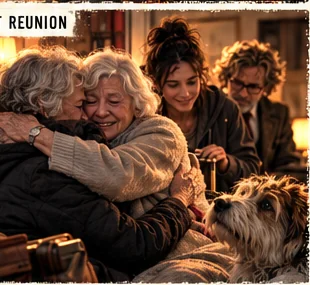
They reached the post office shortly before three. Mrs Bell was waiting at the upstairs window. When she saw the wheelchair, she disappeared from view. A moment later the blue door opened.
“Margaret!”
“Agnes!”
The sisters embraced awkwardly, one seated, the other bending over her. Both began crying. Bernard stood beside Eleanor, uncertain where to look. Mr Pickles approached the wheelchair and accepted several affectionate pats.
Mrs Bell turned towards Bernard. “You found her.”
“Yes.”
“You brought her back.”
“Indeed.”
She took his hand. “Thank you.”
Bernard looked uncomfortable. “Entirely unnecessary, Mrs Bell.”
“No,” she said firmly. “It isn't.”
He opened his mouth, then closed it. There were some situations for which no official response had ever been drafted.
Inside Eleanor's flat, they settled Mrs Finch on the sofa. Her ankle was swollen, but she was otherwise in reasonable spirits. Mrs Bell made tea using water heated on a small camping stove.
Bernard accepted a mug. He held it between both hands. For a moment, the world became almost bearable.
Eleanor sat opposite him. “You know,” she said, “you're quite good at this.”
“At what?”
“Helping people.”
Bernard looked into his tea. “I've been doing it for rather a long time.”
“Yes,” she replied. “But I don't think you realised.”
He considered that. Then he took a sip. The tea was weak. It was also wonderful.
The problem of remaining
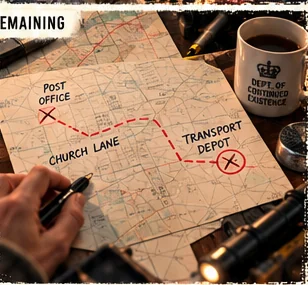
By late afternoon, the question had become unavoidable. They could not remain indefinitely above the post office. There was little food. The water supply had stopped. The radio continued to broadcast occasional fragments, none particularly encouraging. And the number of dead in the streets appeared to be increasing.
Eleanor spread the map across the table. “We need to get out of town.”
Bernard nodded. “I agree.”
“North?”
“Eventually.”
Mrs Bell looked at her sister. “Margaret can't walk.”
“No,” Bernard said.
“And that wheelchair won't last.”
“Probably not.”
Eleanor pointed to the map. “There's a community transport depot near the industrial estate.”
Bernard looked up. “What sort of vehicles?”
“Minibuses. The kind they use for older people and disabled passengers.”
Mrs Finch brightened. “Oh, I've been on those. Very comfortable.”
“Some have wheelchair lifts,” Eleanor continued.
Bernard studied the map. A vehicle. A proper vehicle. Shelter from the weather. Space for supplies. Possibly even a functioning heater. It was almost too much to hope for.
“Do you know whether the depot is secure?” he asked.
“No.”
“Whether the vehicles are operational?”
“No.”
“Whether any fuel remains?”
“No.”
Bernard sighed. “An encouraging quantity of uncertainty.”
Eleanor smiled. “That's the world now.”
He looked at the map again. The depot was less than two miles away. Under ordinary circumstances, he would have considered it a routine journey. Under present circumstances, it might as well have been across the Channel.
Nevertheless, the possibility was there. And Bernard was beginning to learn that possibilities, however inconvenient, were worth investigating.
A requisition without authorisation
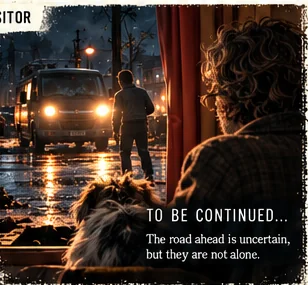
That evening, Bernard sat beside the window with his notebook. The others were sleeping. Mrs Bell and Mrs Finch occupied the bedroom. Eleanor had taken the sofa. Mr Pickles lay curled beside Bernard's chair, one paw resting on his shoe.
Outside, the streets were dark. A distant fire cast an orange glow against the clouds.
Bernard wrote slowly. EMERGENCY CONTINUITY OPERATION: DAY THREE. CIVILIANS ASSISTED: TWO. PERSONNEL: THREE, INCLUDING CANINE. TRANSPORT: TEMPORARY, UNSUITABLE FOR LONG-DISTANCE TRAVEL. NEXT OBJECTIVE: ACQUIRE ACCESSIBLE VEHICLE.
He paused. Under normal circumstances, acquiring a government vehicle required forms, approvals, budgetary authorisation and an uncomfortable conversation with Fleet Management.
He had no forms. No approvals. No budget. And, as far as he knew, no Fleet Management.
He looked at Mr Pickles. The dog opened one eye.
“I believe,” Bernard whispered, “we may have to requisition a minibus.”
Mr Pickles thumped his tail.
“Without authorisation.”
The tail thumped again.
Bernard stared at the notebook. For thirty-two years, he had followed procedure. He had believed in it. He still did. But perhaps procedure had always been a means to an end, rather than the end itself.
Perhaps the purpose of government was not to produce paperwork. Perhaps it was to ensure that people were not abandoned when they needed help.
He wrote one final line. REQUISITION AUTHORITY: EMERGENCY NECESSITY. Then, beneath it: SUBJECT TO RETROSPECTIVE APPROVAL.
He smiled faintly. Some habits, he supposed, were worth keeping.
Outside, a low rumble sounded in the distance. Bernard looked up. An engine. A real engine.
He moved to the window. Far down the street, beyond the abandoned cars, a pair of headlights appeared. They moved slowly through the darkness. Then stopped. A door opened. Someone stepped out.
And a voice called into the empty street. “Hello? Is anybody there?”
Bernard stood perfectly still. Mr Pickles raised his head.
The voice called again. “Please. We need help.”
Bernard reached for his notebook. Then stopped.
For once, he left it on the table.