Stories
The Last Civil Servant
A fictional zombie-apocalypse story. Not official government advice or a live emergency bulletin.

An entirely reasonable objection
Bernard P. Wetherby had always maintained that other people were, in principle, a good thing. Individually, however, they presented difficulties. They were unpredictable, frequently failed to read instructions, and sometimes needed help. Mrs Agnes Bell was presently demonstrating this last characteristic.
‘I really don't think we should go to the post office,’ she said. Beyond a shattered bus shelter three figures stood near the entrance. One had lost a shoe. None moved in a manner Bernard found reassuring.
‘Ah,’ he said. Mr Pickles gave a low growl. They withdrew behind the shelter, where Bernard opened his notebook and wrote: OBSTACLE: THREE HOSTILE INDIVIDUALS. CLASSIFICATION: DECEASED, BUT OPERATIONAL.
‘That doesn't sound very scientific,’ Mrs Bell observed. ‘No,’ Bernard admitted, ‘but I believe it conveys the difficulty.’
A metallic crash sounded beyond the post office. The three figures turned and shuffled away. ‘Interesting,’ Bernard whispered. ‘They respond to noise.’
‘Most people do, Mr Wetherby.’
‘Yes, but these people appear to do so without first assessing whether the noise is any of their business.’
The young woman upstairs
The entrance to the post office was locked. A handwritten sign announced that postal services were temporarily suspended owing to unforeseen circumstances. Bernard felt a brief surge of professional sympathy.
‘At least someone has communicated the position,’ he murmured. Mrs Bell pointed to a narrow blue door. ‘Eleanor lives above it.’
Bernard knocked. ‘Miss Price? My name is Bernard Wetherby. We found your note at the library.’
After a long silence, a voice asked, ‘Who is with you?’
‘Mrs Agnes Bell.’
‘Anyone else?’
Bernard glanced down. ‘A terrier.’
‘A what?’
‘Mr Pickles. He is with the department.’
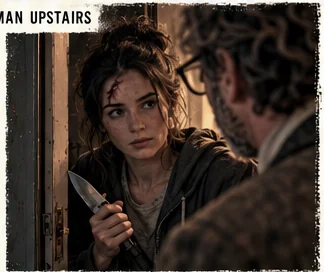
The door opened a fraction. A young woman stood behind it holding a kitchen knife. She was perhaps twenty-eight, with dark hair tied in an untidy knot and a shallow cut across her forehead.
‘The department?’
‘Continued Existence.’
‘You're joking.’
‘I rarely do so intentionally.’
She lowered the knife. Mrs Bell stepped forward. ‘Eleanor, love. Are you all right?’
‘No,’ Eleanor Price said, opening the door. ‘Not particularly.’
An exchange of information
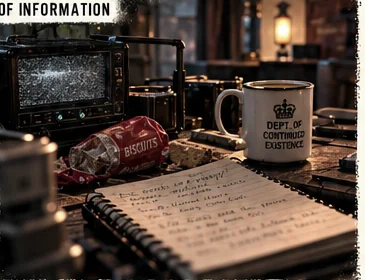
Eleanor's flat smelled of instant coffee and extinguished candles. A battery-powered radio sat on the kitchen table beside handwritten notes and a half-eaten packet of chocolate biscuits. Mr Pickles noticed the biscuits immediately. Bernard noticed the radio.
‘Does that work?’
‘Sometimes. Mostly static.’
He turned the dial. A clipped voice emerged: ‘...remain indoors... avoid... transport hubs...’ Then the signal dissolved.
‘Where did you hear the warning about the station?’ Bernard asked.
‘I went there yesterday. They said evacuation buses were coming. There were hundreds of people. Families. Old people. Children. Then someone started screaming near the ticket barriers.’
She stared at the table. ‘I ran. I didn't wait. I should have helped.’
‘You were in danger,’ Bernard replied.
‘So was everyone else.’
‘Yes,’ he said quietly. ‘They were.’
Mr Pickles placed his paws on Eleanor's knee. ‘You're a scruffy little thing,’ she told him.
‘Assistant Deputy Undersecretary, actually,’ Bernard corrected.
‘You cannot be serious.’
‘It's a provisional appointment.’
She laughed. Briefly, but enough to change the room.
The question of Mrs Bell’s sister
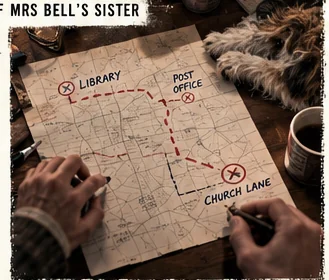
Eleanor knew the street where Mrs Bell's sister lived. ‘Near the church. Ten minutes from here.’
‘Under normal conditions?’ Bernard asked. ‘Then we should allow considerably longer.’
‘Her name is Margaret Finch,’ Mrs Bell said. ‘She's seventy-six. Her knees are bad.’
Eleanor nodded. ‘She comes to the library on Thursdays. Always borrows crime novels.’
‘Terrible ones,’ Mrs Bell said. ‘The more murders, the better.’
Bernard wrote the address in his notebook. Eleanor watched him. ‘Do you write everything down?’
‘Only things that may prove relevant.’
‘Like the dog's job title?’
‘Especially that.’
They spread a map across the table. Eleanor proposed the back streets; Mrs Bell warned against the alley behind the butcher's. Mr Pickles proposed the remaining biscuits.
Bernard recorded the meeting minutes, including apologies: none received.
They agreed that Mrs Bell would remain in the flat while Bernard, Eleanor and Mr Pickles investigated Church Lane.
‘You don't have to,’ Mrs Bell said.
Bernard closed his notebook. ‘No. I suppose I don't.’
Church Lane
The alley behind the post office smelled of damp cardboard and rotting vegetables. Eleanor led the way through a broken fence and a series of small back gardens. Bernard followed with Mr Pickles, whose interest in every scent threatened to extend the journey indefinitely.
‘Stay close,’ Eleanor whispered.
‘I had no intention of doing otherwise.’
They passed a greenhouse with shattered panes and a washing line bearing three shirts that stirred in the wind. Then came footsteps. Slow. Dragging.
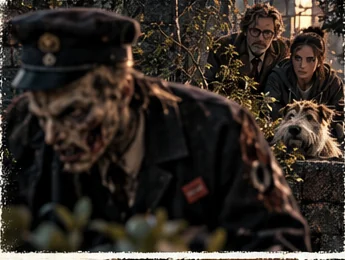
They crouched behind a garden wall. A figure in a postman's uniform shuffled along the pavement. One side of its face was badly damaged.
Bernard recognised him. The man had delivered departmental mail for years and whistled while he worked. The figure stopped, head turning towards the hedge. Mr Pickles stiffened.
Bernard placed a hand on his back. ‘Quietly.’
A distant car alarm sounded. The figure turned and shuffled away.
Eleanor looked at Bernard. ‘You all right?’
He nodded. But he was not. The dead were becoming familiar, and that was worse than anything he had expected.
Number twenty-three
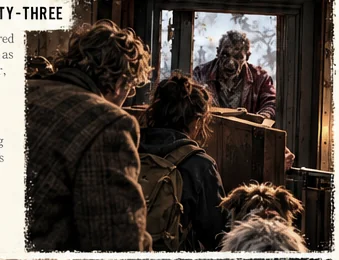
Mrs Finch's house stood at the end of a short terrace. The curtains were closed, the front door locked. Bernard knocked softly and explained that her sister had sent them.
From inside came three faint taps, a pause, and three more.
‘Kitchen,’ a weak voice called.
They went around the back. Through a partly open window Bernard could see an elderly woman sitting on the floor beside the refrigerator, one leg at an awkward angle.
‘Mrs Finch?’
‘Yes. Oh, thank goodness.’
Eleanor reached through the window for a key hanging on a hook. Her fingers brushed it. She stretched farther.
A guttural moan came from the garden path. A man in a bloodstained dressing gown stood at the gate, staring at them. Then he advanced.
‘Bernard!’ Eleanor snatched the key.
Mr Pickles stepped between Bernard and the approaching figure and barked. Bernard's hands shook. Every instinct urged him to retreat.
‘Eleanor,’ he said, ‘open the door.’
They slipped inside as the man reached the steps. Bernard slammed the door; Eleanor wedged a chair beneath the handle. Together they pushed a cupboard against it.
Mrs Finch stared from the floor. ‘Is that the milkman?’
‘No, Mrs Finch,’ Bernard said. ‘I rather think it isn't.’
A question of responsibility
Mrs Finch had fallen the previous evening. Her ankle was badly swollen and she could not stand without assistance. Bernard examined the injury with the limited knowledge provided by a workplace first-aid course several years earlier.
‘I don't believe we should move you unnecessarily,’ he said.
Outside, the banging continued. Eleanor looked towards the barricade. ‘We can't stay here.’
‘I appreciate that.’
‘Then what do we do?’
Bernard looked at Mrs Finch, at Eleanor, and at Mr Pickles standing beside the cupboard with an expression of fierce professional commitment.
He remembered the empty office in Whitehall, the unanswered telephones, the woman waiting above the post office. For thirty-two years he had believed that responsibility was conferred by appointment, delegated through the proper channels and recorded in writing.
Now there were no channels, no ministers, no directors, no instructions. Only people. And the things they needed.
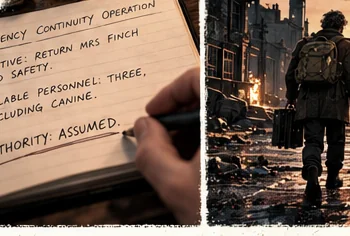
He opened his notebook. His hand shook, but his handwriting remained neat.
EMERGENCY CONTINUITY OPERATION. OBJECTIVE: RETURN MRS FINCH TO SAFETY. AVAILABLE PERSONNEL: THREE, INCLUDING CANINE.
He paused, then wrote: AUTHORITY: ASSUMED.
Eleanor watched him. ‘Well?’
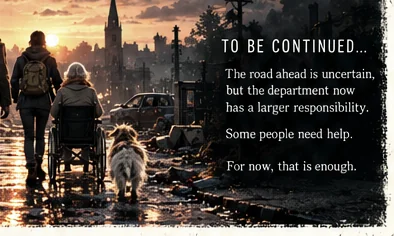
Bernard cleaned his spectacles and put them back on. ‘Miss Price, I believe we shall require a wheelchair.’
The problem with other people
The man outside struck the kitchen door again. The cupboard shifted a fraction. Bernard regarded it with the grave disapproval he usually reserved for unapproved office furniture.
Eleanor searched the kitchen for another exit while Mrs Finch held Mr Pickles' lead. The terrier sat close to her injured leg, alert but remarkably gentle.
‘There is a side passage,’ Eleanor said. ‘But the gate is bolted.’
‘From which side?’
‘Ours.’
Bernard considered this a welcome change in circumstances.
He helped Eleanor shift a narrow table beneath the kitchen window, then checked the garden through the glass. The man was still occupied at the door. Beyond the fence, Church Lane appeared empty.
They would need to move Mrs Finch carefully. They would need a chair with wheels, a safer route and, preferably, considerably less attention from the deceased.
‘We shall proceed in stages,’ Bernard said. ‘First, we establish a suitable means of transport. Second, we secure an exit. Third, we return you to your sister.’
Mrs Finch studied him. ‘Are you really from the government?’
Bernard looked down at his torn tweed jacket and mud-covered shoes.
‘I was,’ he said. ‘At present, I am rather improvising.’
Mr Pickles wagged his tail. Somewhere outside, another voice answered the dead man's moan.
Bernard closed his notebook. The department, it seemed, had a great deal of work ahead of it.