Stories
The Last Civil Servant
A fictional zombie-apocalypse story. Not official government advice or a live emergency bulletin.

An unsatisfactory breakfast
Bernard woke at 06:17 to discover that the world had not improved overnight.
This was disappointing, although not entirely unexpected.
Mr Pickles, meanwhile, had slept exceptionally well. He occupied the centre of a large yellow beanbag in the children's reading corner, his four paws pointing in different directions, his head resting upon Bernard's folded jacket.
Bernard regarded him for a moment.
“I see the accommodation arrangements have been revised without consultation.”
Mr Pickles opened one eye.
“I shall take that as confirmation.”
Outside, the morning was grey and motionless. A thin mist hung between the houses opposite the library. There were no buses, no footsteps, no impatient engines being started by people already late for work. Somewhere in the distance, a burglar alarm emitted three exhausted notes and fell silent.
Bernard sat up, adjusted his spectacles and inspected his shoes. He had slept in them, a practice he had previously associated with railway delays and exceptionally unfortunate Christmas parties.
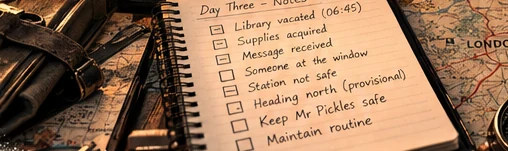
He consulted his notebook.
CONTINUITY OF PUBLIC SERVICE: DAY TWO.
Below this he added: ACCOMMODATION: TEMPORARY. STAFF MORALE: VARIABLE. CATERING: INADEQUATE.
He considered the last entry and underlined it.
Breakfast consisted of a digestive biscuit, a small quantity of water and the remains of a packet of crisps discovered in his briefcase. The crisps had expired three months earlier, but Bernard felt that expiry dates were beginning to lose some of their former authority.
Mr Pickles received half the biscuit.
He regarded this allocation as an opening offer.
“No,” Bernard said. “We must all make sacrifices.”
Mr Pickles placed one paw upon Bernard's knee.
Bernard sighed and surrendered another quarter.
It was becoming apparent that the Department of Continued Existence had developed a serious weakness in its negotiating position.
A communication of uncertain origin
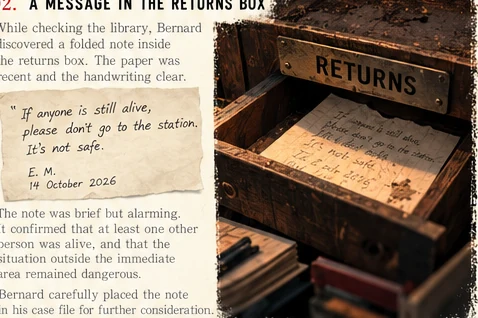
The note was in the returns box.
Bernard found it while conducting what he described in his notebook as a final inspection of the premises. He had checked the windows, examined the emergency exit and returned three books to their correct shelves.
The note was written on the reverse of a library overdue notice.
IF ANYONE IS STILL ALIVE, PLEASE DON'T GO TO THE STATION.
Beneath it, in smaller handwriting: They said there would be buses. There weren't.
And beneath that: Eleanor. Wednesday, 5:40 a.m.
Bernard read it twice.
The handwriting was hurried, the final letters uneven. There was a faint brown smear across one corner. He preferred not to speculate about its origin.
He checked his watch. Wednesday. 06:42.
The message had been written barely an hour earlier.
Mr Pickles sniffed the paper, sneezed and turned towards the front door.
“Yes,” Bernard said quietly. “I noticed.”
He looked again at the name. Eleanor.
Until now, the disaster had consisted of things happening around him. Abandoned vehicles. Empty offices. People who were no longer people in any useful sense of the word.
A name changed matters.
Somewhere nearby was a woman who had survived the night, found a pencil, and taken the trouble to warn a stranger.
Bernard folded the note carefully and placed it in his breast pocket.
He would later tell himself that this was simply good record-keeping.
It was not.
The matter of essential supplies

The high street lay three roads east of the library.
Under normal circumstances, Bernard would have regarded the journey as entirely manageable. It contained a chemist, a bakery, a small supermarket and a shop selling mobile telephone accessories at prices he considered morally ambitious.
Under present circumstances, the distance seemed considerable.
He had prepared a list: drinking water; food suitable for human consumption; food suitable for canine consumption; batteries; a serviceable lead; tea, if available; and information.
The last item troubled him. It was not generally stocked in supermarkets.
They left by the library's side entrance. Bernard locked the door, then checked the handle twice.
Mr Pickles watched with an expression suggesting that certain habits might usefully be reconsidered.
The streets were almost empty. A delivery van rested against a lamppost. A bicycle lay beneath a hedge. On the pavement outside a florist, a bucket of roses had tipped over, scattering red petals into the gutter.
Bernard stepped around them.
At the supermarket, the automatic doors stood half open. Inside, the lights were dead, and a smell of spoiled milk drifted from the refrigeration aisle.
Mr Pickles growled.
Bernard stopped.
Something moved behind the checkout.
A man in a green supermarket uniform rose slowly into view. His face was grey. One arm hung at an unnatural angle. He stared towards them with an expression of profound vacancy.
“Good morning,” Bernard said automatically.
The man made a wet, rasping sound.
Bernard reconsidered the greeting. “Actually, perhaps not.”
He backed away. Mr Pickles stood rigid beside him, the hair along his spine raised. The man shuffled around the checkout.
Bernard retreated through the doors, pulled Mr Pickles close and hurried down the pavement. Only when they reached the corner did he stop to recover his breath.
“Unsatisfactory,” he whispered.
Mr Pickles barked once. “Quite.”
They found supplies at a smaller shop farther along the road. Its front window had been broken, but the shelves remained partly stocked. Bernard collected bottled water, crackers, tinned soup, batteries and two packets of dog food.
He also found tea.
For a moment, he stood perfectly still before the shelf.
“Thank heavens,” he said.
There were several varieties. He selected a familiar brand and placed it carefully in his bag.
At the counter, he counted out the money he had available. It was not enough to cover everything, so he wrote an itemised note, included his name and promised to settle the outstanding balance when normal trading resumed.
He left it beneath a paperweight shaped like a smiling strawberry.
The strawberry's optimism struck him as excessive.
Someone at the window
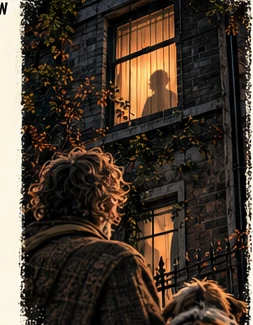
They were halfway back to the library when Mr Pickles stopped.
His ears rose.
Bernard followed his gaze.
Across the road stood a narrow terrace of brick houses. Most of the windows were dark. One upstairs curtain, however, had moved.
Bernard waited. It moved again.
A face appeared briefly between the folds. A woman. Older, perhaps. Grey hair. Pale features. She was looking directly at him.
Bernard raised one hand. “Good morning!”
The curtain closed.
He stood awkwardly in the middle of the pavement.
“Well,” he murmured, “that's understandable.”
Mr Pickles remained facing the house.
Bernard considered his options. He had no wish to intrude. The woman might have perfectly good reasons for remaining indoors. Indeed, given recent events, he could think of several.
He was about to continue when he noticed the front door.
A dark stain spread across its lower panels. The letterbox had been forced outward. And on the doorstep lay a child's red mitten.
Bernard looked up at the window again.
He thought of the note in his pocket. If anyone is still alive.
He crossed the road. The house number was seventeen.
He approached the front door cautiously and knocked. There was no answer. He knocked again.
“Good morning. My name is Bernard Wetherby. I am from the Department of Continued Existence.”
He paused. “That is to say, I was.”
Something scraped inside.
Mr Pickles growled softly.
Bernard stepped away from the door.
From upstairs came a voice. “Don't open it.”
A woman's voice. Thin and frightened.
Bernard looked up. “Certainly not.”
“It's in the hallway.”
Bernard stared at the damaged letterbox. “Ah.”
A heavy thump sounded against the other side of the door. He took another step back.
The woman spoke again. “My husband.”
Bernard felt the words settle between them. He could think of nothing appropriate to say.
Another thump. Mr Pickles barked sharply. Bernard tightened his grip on the lead.
“Madam,” he called, “are you able to leave by another exit?”
“No.”
“Is there a window at the back?”
“Yes. Over the kitchen.”
“Can you reach it?”
A pause. “I think so.”
Bernard looked towards the narrow passage beside the house. A wooden gate blocked the way, secured with a simple latch.
“Then I suggest,” he said, with a steadiness he did not feel, “that we attempt a small change of arrangements.”
A limited evacuation
The garden was little more than a rectangle of paving stones and neglected flowerpots.
Bernard moved a wheelie bin beneath the kitchen window, then tested it with one foot.
It wobbled. He adjusted its position. It still wobbled.
“Government equipment,” he muttered, although the bin belonged to the local council.
Above him, the window opened.
The woman appeared, wearing a blue cardigan over her nightdress. She looked exhausted.
“I'm not very good with heights,” she said.
“Neither am I,” Bernard admitted. “Fortunately, this is not a particularly ambitious height.”
He regretted the remark immediately.
The woman stared down at the bin. Mr Pickles wagged his tail.
“Is that your dog?” she asked.
“Colleague.”
A faint, bewildered smile crossed her face. “Of course.”
Her name was Mrs Agnes Bell.
She was seventy-one, had lived in the house for thirty-eight years, and had spent the previous evening barricaded in the bedroom while her husband, who had died of a heart attack on Monday, moved about downstairs.
Bernard did not ask questions.
He helped her down from the window as carefully as he could. The wheelie bin shifted beneath her feet, but he steadied it with his shoulder.
When she reached the ground, she clutched his arm. For several moments neither spoke.
Inside the house, something struck the kitchen door.
Mrs Bell flinched.
Bernard guided her towards the gate. “Come along,” he said gently. “We needn't stay.”
They reached the pavement without incident. Only then did Mrs Bell begin to cry.
Bernard stood beside her, helpless.
He had attended seminars on conflict resolution, workplace wellbeing and difficult conversations. None had adequately prepared him for this.
He removed a clean handkerchief from his pocket. It was embroidered with his initials.
Mrs Bell accepted it.
Mr Pickles sat beside her and rested his chin against her ankle. She bent to stroke his head.
“What's his name?”
“Mr Pickles.”
A small laugh escaped her, tangled with tears.
“What a ridiculous name.”
“Yes,” Bernard said. “It rather is.”
A temporary expansion of staff
They returned to the library.
Bernard had not intended to return. He had already locked the building and completed the departure checklist. Nevertheless, circumstances had changed.
He was beginning to suspect that circumstances would continue to do so.
Mrs Bell sat in the children's reading corner while Bernard prepared a modest meal of crackers and tinned peaches. He apologised for the absence of plates.
She told him about her husband.
His name had been Arthur. He had repaired clocks. He disliked foreign holidays and loved detective novels. He had never learned to cook anything beyond scrambled eggs, but made them exceptionally well.
Bernard listened. There was little else he could offer.
Eventually Mrs Bell asked where he was going.
“North,” he said.
“Where north?”
“Undetermined.”
“Why?”
Bernard considered the question. “Because remaining here seems increasingly unwise.”
She nodded. “Fair enough.”
He explained his intention to find somewhere safe, somewhere with water, shelter and perhaps a functioning radio.
He did not mention the distant lake he had begun to imagine. It seemed too fanciful, even now.
Mrs Bell looked towards the window.
“I can't come with you.”
Bernard had not asked.
He set down his cup. “May I ask why?”
“My sister lives three streets away. Or lived. I don't know.” She looked at her hands. “I can't leave without knowing.”
Bernard understood. He did not like understanding. It complicated matters.
He opened his notebook. “Address?”
Mrs Bell looked at him. “Sorry?”
“Your sister's address.”
She told him. He wrote it down.
Then, after a moment, he drew a line beneath his earlier entry.
STAFF REMAINING: TWO.
He added: CIVILIAN ASSISTANCE CASE: ONE. STATUS: PENDING.
He looked at Mrs Bell. “We shall make enquiries.”
She stared at him. “You don't have to.”
Bernard closed the notebook.
“No,” he said. “I suppose I don't.”
The unauthorised departure
They left the library shortly after midday.
Mrs Bell carried a small bag containing her spectacles, medication and a photograph of Arthur taken on their wedding day. Bernard carried the supplies. Mr Pickles carried nothing, despite repeated suggestions that he might at least assume responsibility for his own biscuits.
Before leaving, Bernard signed the visitors' book.
DEPARTURE TIME: 12:14. REASON: OPERATIONAL NECESSITY. DESTINATION: SUBJECT TO CONFIRMATION.
He hesitated, then added: LIBRARY SERVICES: APPRECIATED.
Outside, the mist had lifted.
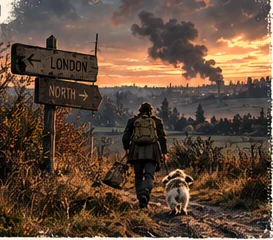
The sun showed faintly through the cloud, illuminating broken glass along the pavement. Somewhere beyond the houses, a column of smoke rose into the pale sky.
Mrs Bell looked at it. “That's near the station.”
Bernard thought of the note in his pocket.
Eleanor. Wednesday, 5:40 a.m.
He took it out and showed her. Mrs Bell read the message. Her face changed.
“Eleanor Price,” she said.
Bernard looked at her. “You know her?”
“She volunteers at the library. Young woman. Dark hair. Lives above the old post office.”
Bernard felt a strange tightening in his chest.
The name had become a person. A person with a home. A person who might still be alive.
Mrs Bell returned the note. “She's a good girl.”
Bernard folded it carefully.
“Then perhaps,” he said, “we ought to establish whether she requires assistance.”
They turned towards the old post office.
Mr Pickles trotted ahead, his tail upright, apparently satisfied that the department was finally beginning to operate at a reasonable pace.
Bernard followed, carrying a bag of supplies, a notebook full of increasingly unmanageable responsibilities and the uncomfortable suspicion that he had just volunteered for something considerably larger than himself.
He glanced back once at the library.
It had been a good shelter. Quiet. Dry. Orderly.
He would have liked to remain there another night.
But the world, it seemed, was no longer particularly interested in what Bernard P. Wetherby would have liked.
He straightened his tie.
“Come along, everyone.”
And for the first time since the collapse, he was not speaking only to a dog.