Stories
The Last Civil Servant
A fictional zombie-apocalypse story. Not official government advice or a live emergency bulletin.
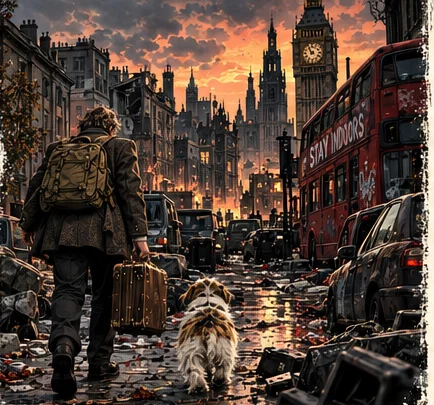
Through the city
By half past six, Bernard P. Wetherby had reached three conclusions. The first was that London had become an exceptionally unpleasant place to be. The second was that his shoes, purchased in 2014 and described by the manufacturer as suitable for extended professional use, were not designed for the end of civilisation. The third concerned Mr Pickles. Mr Pickles had eaten something from beneath an abandoned motorcar. Bernard had elected not to investigate.
They had walked for most of the afternoon, following quieter streets where the houses gradually became smaller and the office blocks gave way to terraces and shops. At intervals Bernard consulted a folded street map. It was becoming increasingly difficult to judge distance. Roads that ought to have been passable were blocked by cars, discarded luggage or the occasional wandering figure whose manner of locomotion did not invite conversation.
Mr Pickles trotted beside him with remarkable good humour. He stopped to inspect lamp-posts, flowerbeds and a particularly objectionable plastic bag. Bernard began to suspect that his new colleague considered the outing a success.
“I should point out,” he said, gently drawing the lead away from the bag, “that this does not constitute an officially sanctioned recreational walk.”
The dog looked up, tail moving. Bernard found himself almost smiling. He had not done much of that since breakfast.
They passed a bus shelter containing three abandoned umbrellas and a timetable still promising a service every twelve minutes. Bernard read the notice out of habit. A distant scream rose from the direction of the high street and ended abruptly.
“Service suspended,” he said, and walked on.
An unexpected find
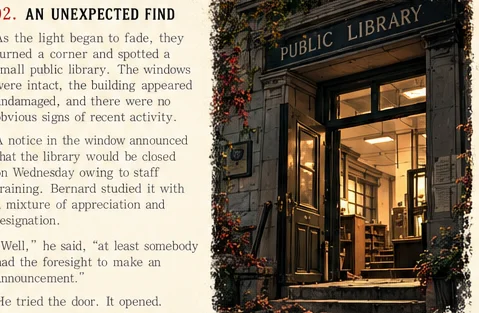
The light was going when Bernard noticed the library. It stood at the end of a modest suburban road, a red-brick building with broad windows and a small bed of rather neglected lavender. The glass was intact. The door was shut. A notice announced that the premises would be closed on Wednesday owing to staff training.
Bernard studied it for a considerable time.
“Well,” he said, “at least somebody had the foresight to make an announcement.”
Mr Pickles scratched his ear.
“I appreciate your position, but we cannot simply wander into the first available building. There are procedures.”
A sound drifted from the far end of the street: several uneven footsteps, followed by a low, wet moan. Bernard glanced towards it and then back at the library.
“Although I imagine the procedures are undergoing revision.”
He tried the door. It opened at once. Bernard sighed.
“Standards.”
Inside, the building smelled of paper, furniture polish and the faint, comforting dust of old carpets. A security light glowed above the reception desk, though nothing else appeared to have power. Bernard waited a moment, listening. No voices. No movement. Only the delicate ticking of a clock whose hands had stopped at four seventeen.
He closed the door behind them and slid the bolt. It was not much of a defence, but it was a beginning. He had always believed that most worthwhile enterprises began with a small, properly recorded action.
A suitable office
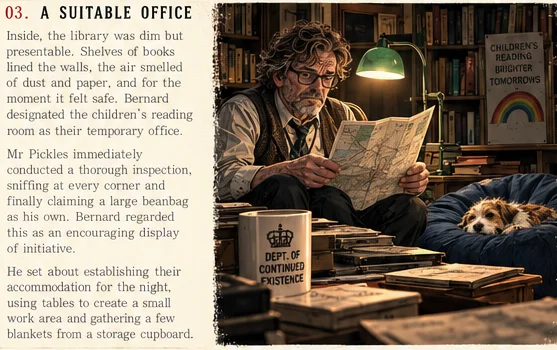
The children's reading room proved to be the most agreeable part of the building. Low shelves contained books about dinosaurs, friendly dragons and the importance of sharing. A painted mural showed a smiling sun over a village where everyone appeared to be both alive and gainfully employed. Bernard found the image almost aggressively optimistic.
He selected a table near the inner wall, away from the windows, and laid out the contents of his briefcase: notebook, pencil, map, emergency folder, torch, two bottles of water, a first-aid kit and a packet of biscuits which had somehow survived the day's proceedings.
“Right,” he told Mr Pickles. “We shall establish a temporary regional office.”
Mr Pickles climbed onto a blue beanbag, turned around three times and settled into its centre.
Bernard regarded him thoughtfully. “A bold claim on departmental furniture. I shall take it under advisement.”
He checked the nearby rooms and the rear exit, then drew the curtains. In a cupboard he found spare blankets and a box of picture books. He carried the blankets to the reading room, taking care not to disturb the dog.
There was a little kitchenette with a tap that produced a reluctant trickle of cold water. Bernard filled what containers he could and placed them together. He was beginning to appreciate the difference between a contingency plan and the thing for which it had been written.
On the wall hung a poster reading EVERYONE BELONGS HERE. Bernard looked at Mr Pickles, now asleep beneath a painted cardboard moon.
“An admirably inclusive policy,” he said quietly.
An evening routine
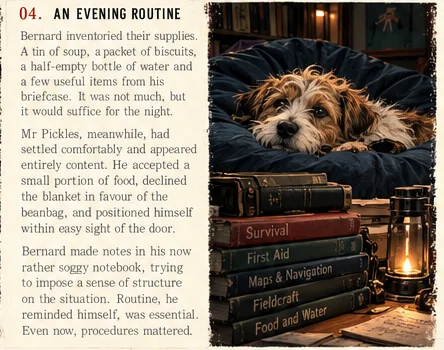
At seven minutes past seven Bernard opened the biscuits. He ate one slowly and gave a small piece to Mr Pickles, whose expression suggested that the allocation had been calculated by a committee with no relevant experience.
“I am afraid we must ration,” Bernard explained. “There is no catering budget.”
He found a tin of soup in the staff cupboard, together with several packets of tea, a small packet of dog treats and a mug advertising the library's summer reading challenge. The electricity was off, and he had no safe way to heat the soup, so he put it aside. The dog treats were a different matter.
Mr Pickles sat upright as Bernard opened the packet. His sudden attention was the most convincing example of staff engagement Bernard had witnessed in years.
“Your enthusiasm is noted,” he said. “I should caution you against expecting rapid promotion.”
After they had eaten, Bernard made an inventory in his notebook. He listed water, food, light, shelter and the possible routes away from the city. Then, after a moment, he added a separate line: CANINE REQUIREMENTS. Beneath it he wrote FOOD, WATER, REST, SECURITY.
He studied the list. It seemed absurdly small compared with the scale of the catastrophe beyond the windows. Yet there was a quiet satisfaction in having made it. The world might no longer be governed by the ordinary rules, but a person could still make a sensible plan and carry it out.
Mr Pickles rested his chin on Bernard's shoe. Bernard shifted his foot very slightly to make the arrangement more comfortable.
Disturbances
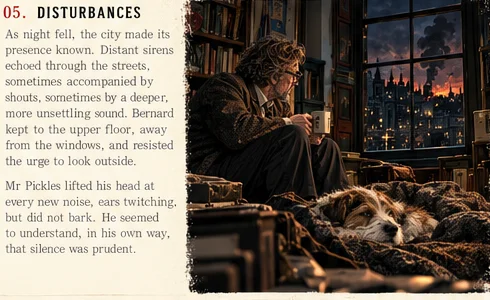
Night came without ceremony. Beyond the curtains the city announced itself in fragments: a distant siren, a crash of glass, a dog barking somewhere beyond the gardens. Then a sound Bernard had heard several times that day, a dragging, aimless movement accompanied by a voice that no longer seemed to belong to a person.
He turned off the torch. In the darkness the library became a collection of familiar shapes made strange. Shelves loomed like walls. The children's mural faded to a pale suggestion of trees. Bernard sat very still, one hand resting on his briefcase.
Mr Pickles raised his head. His ears moved towards the front of the building. A slow scrape came from outside, followed by a dull knock against the glass.
Bernard's heart beat hard enough to make him conscious of his own breathing. He did not move. He had spent a career being told to remain calm in meetings of no conceivable importance. Now, for once, calm seemed a practical requirement.
The knocking came again. Then footsteps, retreating, uneven and faint.
Mr Pickles gave a small questioning whine.
“An unannounced visitor,” Bernard whispered. “We are not accepting appointments this evening.”
He waited another ten minutes before allowing himself to breathe normally. Then he looked down at the dog and realised that his hand had been resting on its back the entire time.
“Excellent work, Mr Pickles,” he said. “No further action required.”
Reflections
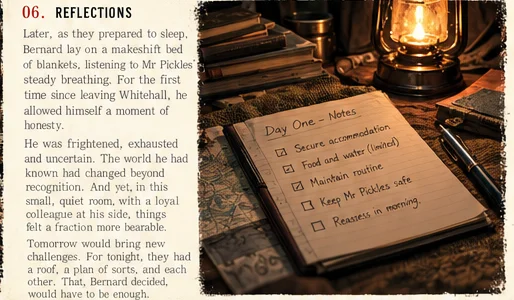
Bernard made a bed from two blankets beside the reading-room table. It was neither warm nor particularly comfortable. He had slept in worse places, though none of them had been selected on the basis that the occupants of the surrounding streets might wish to eat him.
Mr Pickles abandoned the beanbag and curled against his side. Bernard considered moving him back. He did not.
He thought of the office, of the colleagues whose coats were still hanging behind their chairs, and of the messages he had not been able to answer. He wondered whether any of them had found somewhere safe. He wondered whether the people outside the library had families who were still waiting for them.
For the first time all day, he allowed himself to feel frightened. Not in a grand or theatrical way. It was simply a weight beneath his ribs, a knowledge that he could not account for tomorrow or the day after it. He had no manager to consult, no instructions to follow, no reasonable expectation that the world would be repaired by Monday.
Mr Pickles sighed in his sleep and pushed his warm little body closer.
Bernard looked down. “I ought to make clear that this is a temporary arrangement.”
The dog did not wake.
“I cannot promise you anything, you understand.”
Mr Pickles breathed steadily. Bernard reached for his notebook and added one final item to the morning's priorities: KEEP MR PICKLES SAFE.
He closed the book before he could think too much about why he had written it.
A quieter moment

Some time after two, Bernard woke to a noise he could not identify. For several seconds he lay without moving, listening to the old building settle around him. Rain tapped at the window. Somewhere a pipe gave a soft metallic click. There was no knocking at the door.
Mr Pickles was dreaming. His paws twitched against the blanket, and a tiny bark escaped him, so quiet it might have been mistaken for a breath. Bernard watched him with the serious attention he had once reserved for ministerial correspondence.
“Goodness knows what you're chasing,” he murmured.
He pulled the edge of the blanket over the dog's back. It was a small gesture, and he was glad there was no one present to comment upon it.
Beyond the walls the city was changing, perhaps beyond recognition. Bernard could not stop that. He could not restore the telephone lines or locate the missing ministers. He could, however, make certain that a small dog was warm, that there was water for the morning, and that the door remained bolted.
It occurred to him that these were not entirely insignificant achievements.
He settled back against the shelf. Mr Pickles moved in his sleep and placed one paw upon Bernard's sleeve, as if formally acknowledging the arrangement.
“Very well,” Bernard whispered. “An extension of your probationary accommodation. Just for tonight.”
Outside, the rain continued. Inside, two members of the Department of Continued Existence slept, and for a little while neither was alone.