Stories
The Last Civil Servant
A fictional zombie-apocalypse story. Not official government advice or a live emergency bulletin.
An exceptionally poor Tuesday
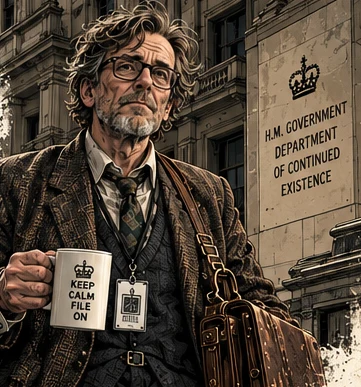
It was, Bernard would later reflect, an exceptionally poor Tuesday. Not the worst Tuesday of his professional career, certainly. There had been the departmental relocation of 2009, during which an entire floor of the building had been moved to Croydon without informing its occupants. There had been the incident with the ministerial goldfish. And there had been the afternoon when someone in Procurement had authorised a new kettle without consulting the Kettle Working Group. Nevertheless, this Tuesday was making a determined effort to distinguish itself.
Bernard P. Wetherby arrived at the Department of Continued Existence at precisely 08:43, seven minutes behind his customary schedule. He was a narrow-shouldered man with tired eyes, a respectable but exhausted tweed jacket, and the expression of someone who had spent thirty-two years being disappointed by perfectly avoidable things. His tie was crooked. His briefcase was not.
He paused beneath the departmental crest, took a sip from the tea he had brought from home, and considered the street. A bus had been abandoned across the pavement. Several people were running in a manner which suggested neither exercise nor punctuality. In the distance a siren rose, faltered, and stopped.
“Public transport,” Bernard murmured. “One never knows.” He adjusted his spectacles and went inside.
A staffing matter
The reception desk was unattended. This was unusual, although not unprecedented. The building had once operated for an entire bank holiday without anyone realising that it was a bank holiday. Bernard signed himself in, because regulations did not cease to apply merely because the receptionist had disappeared, and took the stairs to the third floor.
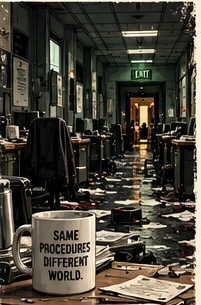
The open-plan office was empty. Half-finished mugs stood beside sleeping monitors. A chair lay on its side. Someone had left a handbag, a coat and an extremely ambitious spreadsheet behind. A sheet of paper on the printer bore the words URGENT CONTINUITY RESPONSE, followed by nothing at all.
Bernard put down his briefcase. He checked the telephone. No line. He checked his mobile. No signal. He checked the kettle. No electricity. This last discovery struck him as particularly serious.
On the noticeboard someone had pinned a handwritten message: THEY ARE COMING. Bernard studied it for a moment. There was no date, no signature, and no indication of which department was responsible for the arrival.
“Typical,” he said.
He retrieved his emergency folder from the bottom drawer. It contained an evacuation map, a list of senior contacts, a torch without batteries, and the minutes of a meeting entitled PREPARING FOR UNFORESEEN CIRCUMSTANCES. The meeting had concluded that unforeseen circumstances would be addressed as and when they arose.
Bernard placed the minutes neatly back in the folder. There was, he supposed, a certain consistency to the present situation.
An unauthorised presence
He was on his way to the ground floor when he heard the scratching. Not a dramatic noise. Not the sort of sound one might expect to precede a major turning point in one's life. Merely the persistent scrape of small claws against a wooden panel.
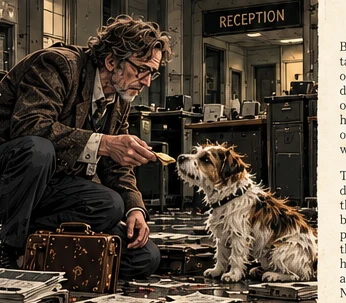
Beneath the reception desk sat a terrier. He was mostly white, with a disreputable patch of brown across one ear, a beard that suggested poor personal management, and bright eyes that had clearly assessed the situation and found it wanting. A broken lead trailed from his collar.
“You do realise,” Bernard told him, “that this is a restricted area?”
The terrier looked at him.
“Although I suppose that particular regulation has become somewhat academic.”
Bernard crouched, with some difficulty, and examined the collar. No name. No telephone number. The dog gave a small, hopeful wag. It was an unreasonable gesture under the circumstances. Bernard looked towards the glass doors, beyond which several people appeared to be moving with a deeply unsatisfactory lack of coordination.
“Where is your responsible adult?” he asked. The terrier offered no information.
Bernard sighed. It was the sort of sigh that had preceded the acceptance of every additional responsibility in his career.
An appointment without precedent
His lunch consisted of a cheese-and-pickle sandwich, a bruised apple, and two digestive biscuits in a paper packet. He had intended to save the biscuits for eleven. Events, however, had begun to demonstrate a cavalier attitude towards the timetable.
“I can offer you half a sandwich,” Bernard said. “There is no pension scheme.”
The dog accepted the sandwich with a dignity that Bernard found reassuring. When the last crumb had disappeared, the terrier settled at his feet as though this concluded the interview process.
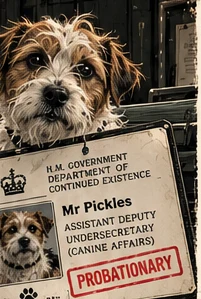
“Very well. Probationary appointment. Three months.”
Bernard found a blank visitor badge and wrote MR PICKLES in his careful departmental handwriting. The name had arrived uninvited, but seemed suitable. He attached the badge loosely to the dog's lead rather than his collar. It would not do to interfere with the animal's comfort.
“Your duties will include security, morale, and such biscuit-related matters as may arise. You will report directly to me. That is not a privilege, I should warn you. It is a consequence of the staffing situation.”
Mr Pickles sneezed.
“Quite.”
Bernard divided the two digestives into equal portions, then revised the allocation in his colleague's favour. He did not record the adjustment.
The first visitors
The banging began at fourteen minutes past ten. Bernard had been attempting to locate the emergency radio when a heavy thud came from the front entrance. Then another. Then a chorus of dull impacts against the glass.
He approached the reception area with Mr Pickles at his heels. Outside stood perhaps a dozen people, though the word stood was doing considerable work. They leaned against one another, shuffled in circles and pressed pale hands against the doors. One wore a security uniform. Another had a briefcase attached to his wrist by a strap. Their faces were wrong in ways Bernard preferred not to catalogue.
A woman struck the glass with her forehead. She did it again, apparently untroubled by the result.
“Have you an appointment?” Bernard asked through the door.
There was no reply worth recording. Mr Pickles growled. Bernard felt a coldness move through his stomach. He had seen the news reports in fragments, and he understood now what the reports had been trying, rather badly, to say.
The people outside were not ill in any ordinary sense. They were dead, or near enough, and they wanted to come inside.
“Well,” Bernard said after a moment, “we shall not be admitting them.”
He drew the inner security grille across the corridor. His hands shook as he turned the key. Mr Pickles remained beside him, watching the door. Bernard was grateful for the company, though he would have described it as operational support.
A necessary withdrawal
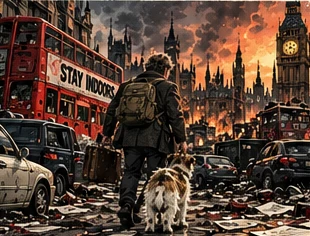
The emergency radio produced static and a clipped voice repeating a warning to remain indoors. Then the transmission failed. Somewhere upstairs, glass shattered. Bernard had always disliked the sound of broken glass in a public building. It usually meant a lengthy insurance form.
He returned to his office and packed what he could carry: the emergency folder, a paper map, a torch, spare batteries from the stationery cupboard, two bottles of water, a small first-aid kit and the remainder of his lunch. He took his personal photograph from the desk, looked at it, and placed it carefully inside his briefcase.
The evacuation plan instructed staff to assemble in the square outside. The square was now occupied by several hundred people displaying the same troubling characteristics as the visitors at reception. Bernard considered this a material change in circumstances.
“Mr Pickles,” he said, “I am invoking the discretionary provisions.”
They went down the service stairs. Bernard moved slowly, listening at each landing. At the rear exit he paused to lock the door behind them. Mr Pickles waited without complaint, which was more than could be said for most of Bernard's former colleagues.
Before leaving, Bernard fixed a note to the inside of the door: OFFICE TEMPORARILY CLOSED. ENQUIRIES WILL BE DEALT WITH IN DUE COURSE. He knew it was ridiculous. He also knew that it mattered to him.
The world outside

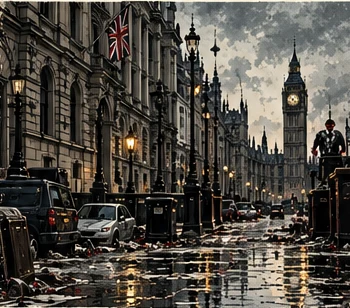
London had become unrecognisable in the space of a morning. Cars sat abandoned at impossible angles. A bus burned at the junction. Papers drifted between the buildings like the remains of an enormous, badly managed filing system. A helicopter crossed the grey sky and vanished behind the rooftops.
Bernard kept to the quieter streets, Mr Pickles close beside him on the shortened lead. Twice they turned back when figures appeared ahead. Once they hid behind a delivery van while a group of the dead wandered past, following a noise neither man nor dog had made. Bernard was not a brave man by inclination. He was, however, observant, cautious and remarkably good at identifying alternative routes.
At a deserted newsagent he found a bottle of water and a packet of dog food. He left money on the counter, along with a note apologising for the lack of exact change.
By midday, the decision had formed itself. London was no longer a sensible place to remain. The department had an old regional continuity file referring to northern sites, water access and radio coverage. Bernard remembered a lake in Cumbria from a holiday taken many years earlier, a place of mist, hills and an almost offensively reasonable pace of life.
He did not imagine that he could reach it quickly. Indeed, he had no particular confidence that he could reach it at all. But a direction was better than none.
“North, I think,” he told Mr Pickles. “A provisional strategy, subject to review.”
Two employees remaining

They reached a patch of open ground on the edge of the city as the light began to soften. Bernard sat on a low wall and took stock. His shoes were muddy. His jacket was torn at one elbow. His briefcase, which had survived departmental relocations, ministerial visits and an incident involving an unsecured photocopier, had acquired a fresh scratch.
Mr Pickles drank from the cap of a water bottle, then leaned against Bernard's leg. It was a small gesture. Bernard stared at the horizon for some time before resting a hand on the dog's head.
He thought of the empty office, the unreturned telephone calls, the faces behind the glass. He thought of the people who might still be alive, frightened and waiting for someone to tell them what to do. He had spent his career passing information along the proper channels. Perhaps the channels were gone. Perhaps information could still be passed.
“We shall need a radio,” he said at last. “A proper one. And somewhere defensible. And a reliable supply of tea.”
Mr Pickles looked up at the final word, perhaps in hope of another biscuit.
“Yes, well. Priorities differ between departments.”
Bernard opened his notebook and wrote: CONTINUITY OF PUBLIC SERVICE. Underneath he added: STAFF REMAINING: TWO. One of them had a tail. Neither had applied for the position.
He closed the notebook. For the first time that day, he allowed himself a small, private smile.
“Come along, Mr Pickles. We have a considerable amount of work to do.”